Ethical Shopping Tools: A Fast Checklist to Avoid Greenwashing

Ethical Shopping Tools for Better Decisions (Without Turning Every Purchase Into Homework)
Mindful shopping gets easier when decisions follow a repeatable process instead of a mood, a trending label, or a rushed last-minute checkout. Rather than trying to become an expert in every product category, a simple framework can help clarify priorities, filter out vague “eco” language, and compare options quickly—while still respecting real-world constraints like budget, sizing, availability, and performance.
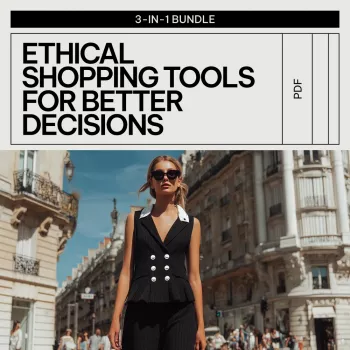
The Ethical Shopping Tools for Better Decisions – 3-in-1 Bundle for Mindful Shoppers is built for exactly that: a practical system to evaluate claims, shortlist alternatives, and make choices that align with values like labor practices, materials, durability, and waste reduction.
What “better decisions” look like for mindful shopping
- Clear priorities: Decide what matters most—fair wages, low-tox materials, animal welfare, plastic reduction, repairability, or something else—so choices don’t rely on guesswork.
- A consistent checklist: Use the same decision steps across apparel, personal care, home goods, and gifts to reduce impulse buys and “research spiral” fatigue.
- Real transparency vs. marketing language: Favor specific, verifiable details over broad claims that sound good but aren’t defined.
- Balanced trade-offs: A “better” decision is one that fits life—budget, time, comfort, availability, and how the item actually performs.
What’s inside the 3-in-1 bundle
- Decision framework: Turn personal values into purchase criteria, including thresholds for what’s a deal-breaker vs. a preference.
- Claim-checking workflow: A structured way to evaluate labels, certifications, ingredient/material disclosures, and brand statements.
- Comparison method: A fast approach for shortlisting options, plus trade-off notes so decisions stay confident and repeatable.
- Pre-purchase planning prompts: Quick checks for needs assessment, use frequency, longevity expectations, and repair plans to reduce waste and regret.
For shoppers who already track ingredients or material choices, this adds structure. For shoppers who feel overwhelmed by “ethical” marketing, it adds clarity and a practical stopping point.
A simple decision flow to use before buying anything
1) Start with the “need” test
- What problem is being solved?
- How often will it be used?
- Is there something already owned that can cover it (or be repaired, altered, or repurposed)?
2) Define 3–5 non-negotiables
Keep it category-specific so the rules stay realistic. For clothing, non-negotiables might include: fiber content, care requirements, wage transparency signals, return policy, and durability cues. For a kitchen tool, it might be: food-safe materials, replaceable parts, warranty length, and packaging minimalism.
3) Collect only the minimum proof needed
- Materials or ingredients list (not just “clean” or “natural”)
- Country of origin and/or supplier information when available
- Certification details (including what the standard actually covers)
- Repair/spare parts availability and warranty terms
4) Rank finalists and write a one-sentence rationale
A single sentence forces clarity: “I chose option B because it meets my non-negotiables (full material disclosure + repair policy), and I’m accepting the higher price for better durability.” This reduces second-guessing later.
How to evaluate “ethical” and “sustainable” claims without getting overwhelmed
Many shoppers get stuck because marketing language is designed to feel reassuring even when it’s not measurable. A calmer approach is to look for specificity, scope, and verification.
For additional guidance on environmental marketing claims, the FTC Green Guides are a useful reference point. For self-declared environmental claims and how they should be stated, ISO 14021 outlines best practices. For company-level social and environmental performance frameworks, see B Lab’s standards and certification.
Quick credibility check for product and brand claims
| Claim type | What to look for | Red flags | Better alternative |
|---|---|---|---|
| Materials | Exact composition, sourcing info, restricted substances policy | “Made with eco materials” with no percentages | Full fiber/ingredient list + clear sourcing statement |
| Labor practices | Audit standard, supplier transparency, corrective action approach | “Ethically made” with no details | Named standard or report + supplier list or traceability |
| Climate impact | Defined boundary (product vs. company), method, updates | One-time number with no methodology | Disclosed method + reduction plan, not just offsets |
| Packaging | Material type, recyclability by region, minimal components | “Recyclable” without local feasibility | Clear disposal guidance + reduced packaging volume |
Where these tools help most
Building a repeatable routine (so mindful shopping takes less time)
Featured bundles to support smarter choices
- Ethical Shopping Tools for Better Decisions – 3-in-1 Bundle for Mindful Shoppers (a structured framework for comparisons, claim checks, and confident trade-offs)
- Summer Skincare Secrets Bundle | 3-in-1 Digital Guides for a Summer Skincare Routine (helpful for shoppers who want more structure around product routines and ingredient awareness)
- Content That Sells Strategy Toolkit | How to Create a Content Marketing Strategy 3-in-1 Bundle (a separate toolkit for planning and decision-making—useful if you also want clearer systems in other areas)
Who the bundle is a good fit for
FAQ
Does this bundle help spot greenwashing?
Yes—its claim-checking workflow prioritizes specificity, scope, and verification, helping separate measurable details (like full material percentages or named audit standards) from broad slogans (like “eco-friendly” with no definition). It also encourages checking whether a claim applies to the whole product or only a small component.
How much time does it take to use the tools before a purchase?
A quick check can take about 5–10 minutes when you’re only confirming essentials like materials, return policy, and one credible proof point. A deeper dive for higher-cost items may take 20–30 minutes, and repeat use tends to get faster as your non-negotiables and standards list are already set.
Will this work for any product category?
The core framework is flexible across categories because it focuses on setting priorities, gathering minimum evidence, and documenting trade-offs. What changes by category are the non-negotiables and the best evidence sources (for example, fiber and care requirements for apparel vs. ingredient disclosure for personal care).














Leave a comment