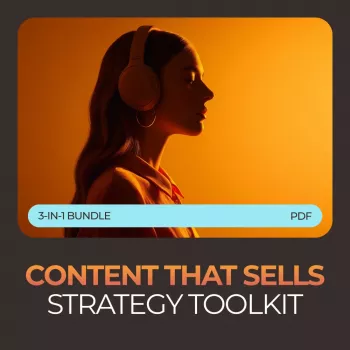
Content That Sells Toolkit: 3-Step Content Strategy System

Content That Sells Strategy Toolkit: A Practical 3-Step System to Plan, Create, and Publish High-Impact Content
A content plan only works when it turns attention into measurable action. The most reliable way to get there is to use a repeatable workflow that keeps positioning, messaging, and publishing decisions consistent—so content doesn’t drift into “nice to have” ideas that never connect to revenue. Below is a toolkit-style system you can run in cycles, whether you’re a solo operator or a small team.
What “Content That Sells” Means in Practice
“Content that sells” isn’t hype or hard-sell copy. It’s content designed to move a reader through a decision path: problem clarity → solution fit → trust → next step. Each piece should do one primary job and do it well.
- Assign every piece a single job: attract, educate, compare, convert, or retain.
- Use consistent promises, proof, and outcomes so value is recognizable in seconds.
- Define “sells” based on your model: leads booked, trials started, products purchased, renewals, or referrals.
If you want a baseline definition to align a team, the Content Marketing Institute frames content marketing around creating and distributing valuable, relevant content to drive profitable action—profitability is the point, not just reach.
Step 1: Start with Strategy Inputs (Audience, Offer, Positioning)
Most content programs stall because inputs are fuzzy. Lock these down before you build a calendar:
- Audience snapshot: role, awareness level, urgency, budget constraints, decision criteria.
- Offer snapshot: what it is, who it helps, how it works, what results look like, and what it replaces.
- Positioning statement: specific audience + specific outcome + unique mechanism + proof signal.
- One north star goal (60–90 days): qualified calls, cart checkouts, or email sign-ups.
Strategy inputs that prevent content from drifting
| Input | What to decide | Example output |
|---|---|---|
| Primary audience segment | Who the next 100 customers should resemble | Early-stage founders selling a digital product |
| Core problem | What keeps them stuck right now | Inconsistent leads from content |
| Desired outcome | What success looks like to them | Predictable weekly inquiries |
| Unique mechanism | Why this approach works differently | A repeatable content system with templates and checkpoints |
| Proof signals | Evidence that increases trust | Case results, testimonials, benchmarks, process transparency |
When you need an extra guardrail for quality, Google’s guidance on helpful, reliable, people-first content is a strong standard: demonstrate first-hand usefulness, be specific, and avoid thin generalities.
Step 2: Build a Simple Content Map (Pillars, Angles, Assets)
A content map converts strategy into a repeatable set of topics and formats that your audience actually needs at each stage of the decision.
- Choose 3–5 pillars tied directly to buyer questions and objections (not broad categories).
- List angles per pillar: beginner-friendly, advanced, myth-busting, comparison, troubleshooting, case-based.
- Assign formats by effort and reuse potential: long-form guide, short post, email sequence, checklist, script.
- Create an asset ladder: one core piece becomes multiple supporting pieces across channels.
Example: one cornerstone guide can become (1) a comparison checklist, (2) three short troubleshooting posts, (3) a 5-email sequence, and (4) two sales enablement snippets for follow-ups.
Step 3: Turn the Map into a 30-Day Publishing Plan That’s Actually Doable
Consistency beats intensity. A realistic cadence is one you can sustain through drafting, review, approvals, and distribution.
- Pick a cadence based on capacity (writing time, review time, design time, approvals).
- Batch by stage: research → outline → draft → edit → publish → repurpose.
- Set distribution rules: where each piece goes first, then how it’s reshaped for secondary channels.
- Use a minimum viable schedule: 1 cornerstone + 4–8 supporting pieces + 4–8 social/email touchpoints.
Messaging That Converts: Hooks, Structure, and Calls to Action
Measure What Matters: Content Scorecards and Quick Fixes
A lightweight content scorecard
| Metric | What it indicates | When to act |
|---|---|---|
| Scroll depth / time on page | Content relevance and structure quality | If low, improve opening + add clearer subheads |
| Clicks to next step | CTA clarity and offer fit | If low, tighten the CTA and reduce competing links |
| Email sign-ups / leads | Value exchange strength | If low, upgrade the lead magnet promise and placement |
| Assisted conversions | How content supports buying decisions | If flat, add comparison and proof sections |
| Repurpose performance | Efficiency of the asset ladder | If weak, tailor snippets per platform instead of copy-paste |
Using a Toolkit Workflow: Why Bundled Strategy Resources Help
Recommended Bundles for Building a Repeatable Content System
- Content That Sells Strategy Toolkit | How to Create a Content Marketing Strategy 3-in-1 Bundle ($265.99)
- Grow Your Business Step-by-Step: 10-in-1 Bundle for Online Success ($424.99)
Quick fit check
| If the current situation is… | This toolkit approach helps by… |
|---|---|
| Publishing inconsistently | Providing a repeatable plan and prompts to keep production moving |
| Lots of content but few results | Re-centering content around buyer questions, proof, and CTAs |
| Unclear messaging across channels | Standardizing positioning and content structure |
| Limited time/resources | Turning one core asset into multiple pieces via an asset ladder |
For additional planning perspectives, HubSpot’s overview of how to create a content marketing strategy reinforces the same core themes: clear audience definition, consistent publishing, and measurement tied to outcomes.
FAQ
What are the core parts of a content marketing strategy?
The core parts are audience definition, positioning and messaging, content pillars, a distribution plan, a realistic publishing cadence, and measurement checkpoints that tie content to business outcomes.
How long does it take to build a working content plan?
A workable plan can take a few hours to a few days depending on research depth. A strong approach is to run a 30-day pilot, then improve weekly based on performance data and sales feedback.
How do you know if content is driving sales rather than just traffic?
Track clicks on primary CTAs, email sign-ups, lead quality, and assisted conversions—not only pageviews. Compare results by content job (educate vs. convert) to see which pieces actually move buyers forward.















Leave a comment